
Prompt Engineering for Beginners: Write Perfect Instructions in 5 Minutes
Master prompt engineering for beginners with our 2026 guide. Learn the ROIF framework to write better AI prompts today and stop getting generic AI results.
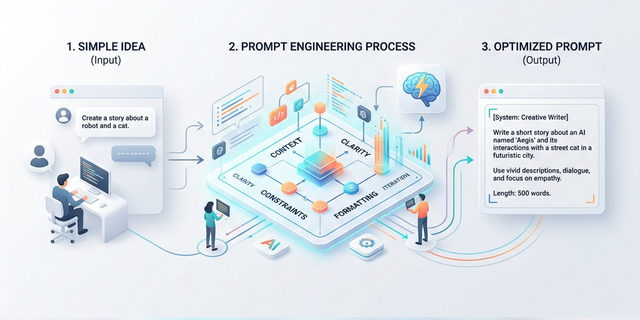
If you are feeling overwhelmed by the flood of AI tools hitting the market, take a breath. You are not alone.
Quick Summary:
- ROIF Framework: Use Role, Objective, Instructions (Context/Constraints), and Format.
- Persona Anchor: Assign a role (e.g., Expert Tutor) to change vocabulary and tone.
- Declarative Goals: Use strong verbs (Summarize, Classify) instead of vague ones.
- Constraint Design: Use negative constraints to prune robotic intros and clichés.
- Iteration Cycle: Treat the first response as a draft and refine with follow-up logic.
Millions of people are trying to figure out how to make Large Language Models (LLMs) like ChatGPT, Claude, and Gemini actually useful for their daily lives. The secret does not involve learning a programming language or getting a degree in computer science. The secret is simply learning how to talk to the machine. That skill is called prompt engineering for beginners, and by the end of this guide, you will know exactly how to write better AI prompts today.
In this comprehensive breakdown, we are going to strip away the complex jargon. We will uncover exactly why AI models sometimes give you generic, robotic, or completely incorrect answers—and more importantly, how you can fix it. You will learn the core frameworks that professionals use, see side-by-side examples of bad vs. good prompts, and get actionable templates you can copy and paste immediately.
Looking for a shortcut? If you want to see prompt engineering in action immediately, use our free optimizer on the homepage to instantly watch a basic sentence transform into a professional-grade prompt.
What is Prompt Engineering for Beginners?
To understand prompt engineering, we must first understand what an AI prompt actually is. A prompt is simply the text, question, or instruction you type into the chat box of an AI model to initiate a response. Therefore, prompt engineering is the deliberate, thoughtful craft of designing those instructions so the AI returns exactly what you want, in the format you want, without requiring you to ask five follow-up questions.
Think of an AI like an incredibly eager, highly educated intern who has no common sense and zero context about your life. If you tell this intern, "Write an email to my boss about the project update," they will write a completely generic email because they don't know your boss's name, the project's details, your company's tone, or what needs updating.
However, if you say, "You are an experienced project manager. Write a concise, bulleted email to my boss, Sarah. The project is the 'Q3 Website Redesign'. The update is that we are on schedule, but we need her approval on the final logo by Friday. Keep the tone professional but warm." — the resulting email will be perfect on the first try.
That difference is the essence of prompt engineering.
Why Learning Prompt Engineering for Beginners Changes Everything
Many users dabble with AI, type in a vague request like "Give me ideas for a blog post," get a robotic, boring list, and conclude that AI isn't very helpful yet. This is a massive mistake.
The quality of the output is a direct mirror of the quality of the input. When you master the basics of prompt engineering, three things happen:
- Massive Time Savings: You eliminate the frustrating process of arguing with the AI. You stop having to say, "No, make it shorter," or "I meant format it as a table."
- Higher Quality Thinking: AI models are "next-token prediction engines." When you provide a rich, detailed prompt, you give the AI better mathematical probabilities to draw from, literally forcing it to generate deeper, more nuanced, and less generic thoughts.
- Scalable Productivity: Once you know how to write a good prompt, you can save it as a template and use it every single week to automate repetitive tasks.
Core Concepts of Prompt Engineering for Beginners
To write better AI prompts today, you need to understand three fundamental concepts. These are the building blocks of every great prompt.
1. The Model Has No Memory (Unless You Give It One)
Every time you open a new chat window, the AI has amnesia. It does not know who you are, what your business does, what your writing style is, or what you talked about yesterday. You must inject all necessary context into the prompt itself. Context is the anchor that prevents the AI from drifting into generic generalities.
2. Clarity Beats Cleverness
AI does not understand sarcasm, subtle hints, or reading between the lines. It processes language literally. If you use vague verbs like "Look over this" or "Fix this," the AI has to guess what you mean. Does "fix" mean check the grammar, rewrite the tone, or verify the facts? Be declarative. Use strong verbs like "Summarize," "Translate," "Proofread for spelling," or "Rewrite to sound more professional."
3. Constraints Breed Creativity
We intuitively think that giving the AI total freedom will result in the best ideas. The opposite is true. If you ask for "a story," you get a boring story. If you ask for "a 500-word sci-fi story about a barista on Mars who discovers a time machine in the espresso maker, written in the style of a film noir detective novel," you get something incredibly creative. Constraints force the AI to combine specific concepts in unique ways.
The "ROIF" Framework: Write Better AI Prompts Today
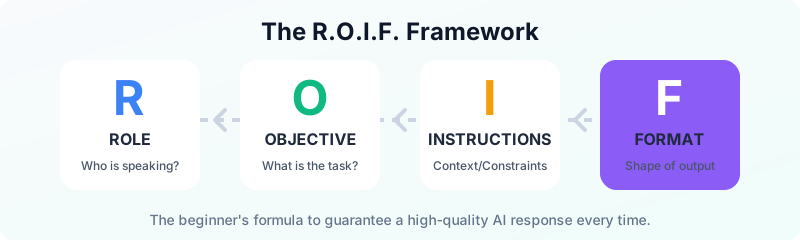
If you only remember one thing from this article, memorize the ROIF Framework. It is the easiest way to structuralize your thinking and guarantee a high-quality response.
ROIF stands for: Role, Objective, Instructions (Context/Constraints), and Format.
Let's break down how to apply this framework to drastically improve your results.
Step 1: Assign a ROLE
AI models have internalized the writing styles of millions of professions. If you don't assign a role, the AI speaks in its default, slightly robotic "helpful assistant" voice. By assigning a role, you instantly change the vocabulary, tone, and depth of the response.
- Weak: "Explain quantum mechanics."
- Better: "Act as a passionate high school physics teacher explaining quantum mechanics to a 10th grader."
- Better: "Act as a postdoctoral quantum physics researcher writing an executive summary for a grant application."
Step 2: Define a Clear OBJECTIVE
What is the single, primary task you want accomplished? State it clearly and early. Do not bury the main request at the bottom of a massive paragraph.
- Weak: "I have a long meeting transcript here and I don't really know what to do with it, it's too long to read."
- Better: "Your objective is to read this meeting transcript and extract the key decisions made."
Step 3: Provide INSTRUCTIONS (Context & Constraints)
This is where you give the AI the boundaries it needs to succeed. Who is the audience? What tone should it use? What should it absolutely avoid doing?
- Weak: "Make it sound good."
- Better: "Context: This is going to the executive team. Constraints: Keep the tone strictly professional, avoid using marketing buzzwords like 'synergy' or 'disruptive,' and ensure the total length is strictly under 300 words."
Step 4: Specify the FORMAT
This is the most frequently forgotten step in prompt engineering for beginners. Don't let the AI decide how to show you the data. Tell it exactly what output structure is most useful for you.
- Weak: "Give me local marketing ideas."
- Better: "Format your response as a markdown table with three columns: Idea Name, Estimated Budget, and Expected Time to Implement."
Before and After: The Anatomy of a Perfect Prompt
Let's look at how the ROIF framework transforms a weak prompt into a masterclass.
The Vague Prompt (What most beginners do):
"Write a blog post about healthy eating habits."
Why it fails: It lacks a role (who is writing?), an audience (who is reading?), constraints (how long?), and format. The result will be a generic, boring essay that sounds like a Wikipedia article.
The Engineered Prompt (Applying the ROIF Framework):
"[Role] Act as an engaging, sympathetic registered dietitian who specializes in busy working professionals. [Objective] Write an introductory blog post about building sustainable, healthy eating habits. [Instructions/Context] The target audience is parents who work 9-to-5 jobs and feel they don't have time to cook. Focus only on 3 highly actionable, realistic habits (e.g., meal prepping on Sundays). Do not suggest expensive supplements or complicated diets. Keep the tone encouraging, warm, and highly practical. [Format] Format the post with a catchy H1 title, a short hook introduction, an H2 heading for each of the 3 habits with bullet points under each, and a concluding call-to-action to subscribe to our newsletter."
The difference in the output generated by these two prompts is staggering. The second prompt will yield a piece of content that is 95% ready to publish, saving you hours of editing.
Advanced Techniques in Prompt Engineering for Beginners
Once you master the ROIF framework, you can start layering in advanced techniques that truly unlock the power of modern LLMs. If you want to dive deeper into these mechanics, we highly recommend reading our detailed guide on How to Improve Your ChatGPT Prompts.
1. Few-Shot Prompting (Providing Examples)
Sometimes, explaining exactly what you want is harder than just showing an example. "Few-shot prompting" simply means providing the AI with 2 or 3 examples of the desired output before giving the actual task.
For example, if you want the AI to classify customer support tickets, you provide examples first:
"Here are examples of how I want you to classify messages: Message: 'My screen is cracked.' -> Category: Hardware Repair Message: 'I forgot my password.' -> Category: Account Access Now classify this message: 'The app keeps crashing when I open it.'"
2. Chain-of-Thought (Asking the AI to "Think")
When you ask an AI a complex math or logic question, it often guesses the final answer immediately and gets it wrong. You can dramatically improve its accuracy by adding one simple phrase to the end of your prompt: "Think step-by-step before answering." This forces the model to generate its reasoning process aloud, calculation by calculation, which reliably leads to the correct conclusion.
3. The Power of Negative Prompting
Telling the AI what not to do is a crucial skill in prompt engineering for beginners. Often, models will try to be overly helpful by adding long introductions, apologies, or generic conclusions (e.g., "In conclusion, healthy eating is a tapestry of choices..."). You can stop this behavior with strict negative constraints:
- "Do not write an introduction or conclusion."
- "Do not use the words 'tapestry,' 'landscape,' or 'moreover.'"
- "Do not apologize if you cannot find the answer."
Common Mistakes Beginners Make (And How to Fix Them)
As you embark on your journey to write better AI prompts today, watch out for these common pitfalls:
- The Mega-Prompt Trap: Don't try to get the AI to write a 50-page ebook, format the cover, edit the grammar, and generate marketing copy all in one prompt. Break complex tasks down. Have one prompt for the outline, one prompt for chapter 1, one prompt for editing, etc.
- Asking Leading Questions: If you ask the AI, "Is eating 50 apples a day a good idea?", it might try to agree with your premise. Instead, ask neutrally: "What are the medical pros and cons of eating 50 apples a day?"
- Treating it like Google: Google is a search engine; you use 2-3 keywords. AI is a reasoning engine; you use full sentences and paragraphs. Stop typing "best marketing strategies" into ChatGPT. Instead type, "Act as a CMO and list the top 3 low-budget marketing strategies for a local bakery."
Ready-to-Use Prompt Templates to Start Today
To make this actionable immediately, copy and paste these templates. Just fill in the bracketed information.
The Simplifier (Great for Learning Complex Topics)
"Explain [COMPLEX TOPIC] to me. Act as an expert tutor talking to a high schooler. Use analogies related to [YOUR HOBBY/INTEREST]. Keep the explanation under 3 paragraphs and use bullet points for the main takeaways."
The Email Polisher (Great for Professional Communication)
"Review the following drafted email. Context: I am sending this to a client who is unhappy about a delayed project. Objective: Rewrite it to sound professional, empathetic, and solution-oriented. Constraints: Do not make promises about specific deadlines. Remove any defensive language. [PASTE DRAFT HERE]"
The Ideation Engine (Great for Brainstorming)
"I am working on [YOUR PROJECT/PROBLEM]. Give me 10 unconventional, out-of-the-box ideas to solve this. Act as a creative director at a top agency. Format the response as a numbered list with the Idea Name in bold, followed by a one-sentence explanation of why it works."
For an entire database of ready-to-use, highly engineered frameworks, be sure to explore our extensive Prompt Library where you can find templates for coding, HR, sales, and content creation.
The Real Secret: Iteration
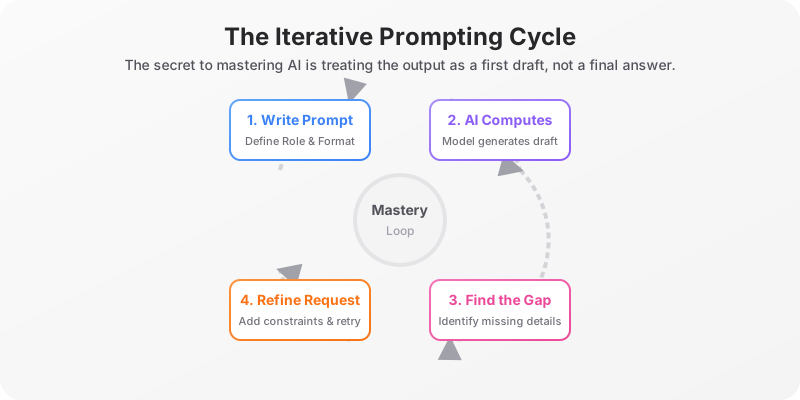
The final lesson in prompt engineering for beginners is understanding that nobody writes the perfect prompt on the first try. You will inevitably get a response that isn't quite right. That is part of the process.
Instead of starting over, iterate. Reply to the AI with corrections:
- "This is good, but make it 50% shorter."
- "Rewrite this, but remove all the formal language and make it sound conversational."
- "You forgot to format it as a table. Please redo it."
Treat the AI like a collaborative partner. The more you practice, the more intuitive the ROIF framework will become. Soon, injecting roles, objectives, context, and formatting constraints will be second nature.
Conclusion: Start Writing Better AI Prompts Today
Prompt engineering is the modern equivalent of learning how to use a search engine in the late 1990s. It is a foundational digital skill that will dictate your leverage in the modern workplace. By adopting a structured approach rather than treating the AI like a magical mind-reader, you take control of the output.
You now have the tools, the ROIF framework, and the understanding of context and constraints necessary to drastically elevate your interactions with AI.
Ready to see these principles applied automatically? Don't waste time struggling manually. Head over to our homepage and use our free Prompt Optimizer tool. Simply paste in your raw, unstructured ideas, and watch as it instantly transforms your text into a masterfully engineered prompt using the exact frameworks we've discussed. Stop guessing, and start commanding the AI today!
Written by Engineering Team, ImprovePrompt. Last updated March 7, 2026.
Frequently Asked Questions
What is prompt engineering for beginners?
Do I need to know how to code to learn prompt engineering?
Why do my AI prompts generate generic answers?
What is the easiest way to write better prompts today?
Start Writing Better Prompts
Ready to put these techniques into practice? Our free AI prompt optimizer analyzes your intent and rewrites your request for maximum effectiveness.
Optimize Your Next Prompt Now