
Top 5 Free & Paid AI Prompt Improver Tools You Need in 2026
Stop guessing what works. Discover the best AI prompt improver tools of 2026, comparing free and premium options like ImprovePrompt.ai, PromptPerfect, and more.
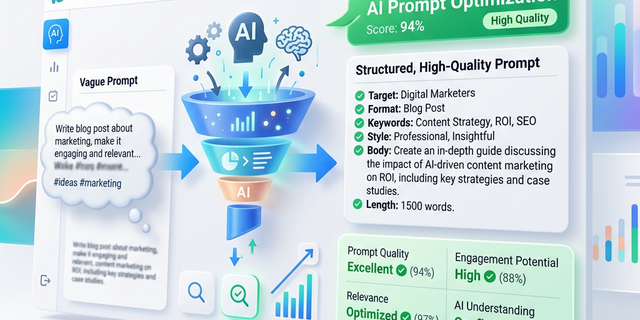
If you’ve spent any meaningful amount of time working with Large Language Models (LLMs) over the past year, you already know the frustrating reality: what you type is rarely what you get on the first try.
Quick Summary:
- Efficiency Gains: Automate the 3-5 iteration cycle into a single, high-fidelity step.
- Top Tool (Overall): ImprovePrompt.ai for instant 6-layer structural optimization.
- Enterprise Scaling: Use PromptPerfect for multi-model testing and API proxying.
- Claude Optimization: Use Anthropic Console’s native XML-tagging optimizer.
- Specialized Visuals: Use PromptHero or Noonshot for Midjourney camera physics.
You ask for a simple marketing email, and you get a generic wall of text. You ask for a code review, and you get a surface-level critique. The problem isn’t the AI—it’s the prompt. Fortunately, the landscape has evolved, and finding the Best AI Prompt Improver Tools is now the highest-leverage decision you can make for your personal or team productivity in 2026.
In the early days of generative AI, prompt engineering was a highly manual, tedious process. Practitioners spent hours reading documentation, searching Twitter for 'prompt hacks,' and manually iterating on instructions to squeeze better reasoning out of ChatGPT, Claude, or Midjourney. But as models have become more sophisticated, so has the ecosystem around them. Today, we don't have to guess what works. We have dedicated software designed specifically to analyze, rebuild, and optimize our requests before they even reach the underlying model.
New to prompt optimization? Try our free optimizer directly on the homepage to instantly see how a weak prompt transforms into a highly structured, production-ready instruction set.
Whether you are a solo content creator trying to maintain a consistent brand voice, a developer building complex RAG (Retrieval-Augmented Generation) applications, or a marketing team trying to scale content production, using a prompt improver is no longer optional—it is a necessity. In this comprehensive guide, we will break down the top tools on the market today, comparing free and premium options, and explaining exactly how they can save you hours of wasted iteration.
The ROI of Prompt Optimization
Before diving into the specific platforms, it’s worth asking: why invest time or money into a prompt improver at all? Can’t you just learn to write better prompts yourself?
While learning the core principles of how to improve your ChatGPT prompts is incredibly valuable, the reality of daily work is that doing things manually doesn't scale. Here is the true Return on Investment (ROI) of an automated prompt improver:
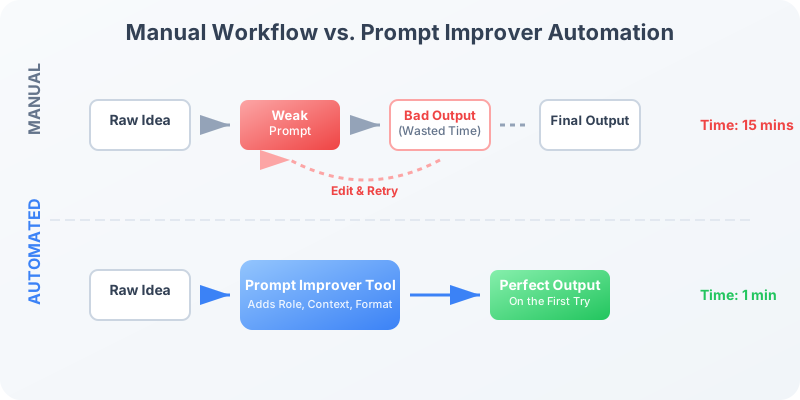
- Saved Tokens and API Costs: Every time an LLM gives you a bad response, you have to run a follow-up prompt. If you are using API access or a usage-capped tool, those 'try again' prompts cost real money. A prompt improver ensures your first shot is your best shot, drastically reducing token waste.
- Time Recovery: It takes the average user 3 to 5 back-and-forth interactions to get an LLM to produce exactly what they want. An optimizer collapses that iteration cycle into a single step, saving 5–10 minutes per task. Over a year, that is hundreds of hours recovered.
- Consistency: If you ask three different employees to write a prompt for a blog outline, you will get three vastly different outputs. A prompt improver enforces a standardized architecture—Role, Objective, Context, Constraints, Format—meaning your outputs remain consistent regardless of who is typing the request.
- Learning Through Osmosis: The best tools don’t just fix your prompt; they show you why they fixed it. By seeing how a weak prompt is rebuilt, you naturally become a better prompter over time.
Now, let's explore the standout tools dominating the market this year.
Criteria for Evaluating the Best AI Prompt Improver Tools
To create this list, we evaluated tools based on a strict set of criteria focused on real-world utility:
- Model Agnosticism: Does the tool only work for ChatGPT, or does it generate prompts that also perform well on Claude, Gemini, and Llama?
- Structural Architecture: Does it just add adjectives, or does it actively restructure the prompt to include roles, few-shot examples, and output schemas?
- Ease of Use: Can a non-technical user get value from it immediately without reading a massive manual?
- Cost vs. Value: Does the premium version justify the price tag compared to excellent free alternatives?
- Specialization: Is it built exclusively for text, or does it also handle complex image generation prompts (like Midjourney and Stable Diffusion)?
Based on these benchmarks, here are the top platforms available today.
1. ImprovePrompt.ai (Best Overall for Daily Users)
- Pricing: Free
- Best for: Professionals, creators, and teams who want instant, structured optimization without a steep learning curve.
It might seem biased to put our own tool first, but ImprovePrompt.ai was built precisely to solve the gaps left by other platforms. Instead of simply lengthening your prompt, ImprovePrompt restructures your raw request according to the proven 6-layer prompt architecture (Role, Objective, Context, Constraints, Output Contract, Quality Bar).
Key Features:
- Instant Restructuring: Paste a messy 'brain dump' into the tool, and it instantly transforms it into a highly legible, token-efficient system prompt.
- Technique Explanations: It doesn't just rewrite your prompt—it explains the specific techniques applied (e.g., 'Added Chain-of-Thought reasoning to prevent logical jumps'). This makes it an educational tool as much as a utility.
- Extensive Template Ecosystem: The built-in Prompt Library offers hundreds of pre-optimized frameworks for coding, marketing, HR, and sales.
- Completely Free: Currently entirely free to use without gated paywalls for core features.
If you want a tool that lives in an open tab and consistently turns vague ideas into laser-focused instructions, this is the daily driver you need.
2. PromptPerfect (Best for Enterprise & API Power Users)
- Pricing: Freemium (Paid tiers start around $9.99/mo)
- Best for: Developers and enterprise teams running prompts at scale.
PromptPerfect has been one of the heavyweights in the optimization space for several years. It is designed to sit between the user and the underlying LLM API, intercepting the prompt, optimizing it, and then passing it through to the chosen model.
Key Features:
- Multi-Model Testing: A standout feature is the ability to run your optimized prompt against multiple models simultaneously (e.g., GPT-4o, Claude 3.5 Sonnet, and Gemini Pro) to see which yields the best result.
- Behind-the-Scenes Optimization: For API users, PromptPerfect acts as a proxy wrapper, allowing developers to improve user inputs dynamically before hitting the costly LLM backend.
- Few-Shot Integration: It has built-in tools for managing few-shot examples, which is critical for complex classification or data-extraction pipelines.
Drawbacks: The interface can be slightly overwhelming for casual users, and the cost can escalate if you are running thousands of API calls through their optimizer layer.
3. Anthropic Console Prompt Generator (Best for Claude Enthusiasts)
- Pricing: Free (Requires Anthropic API account)
- Best for: Developers building strictly on the Claude ecosystem.
Anthropic (the creators of Claude) introduced a built-in Prompt Generator within their API console, and it is a masterpiece of specialized optimization. Because Claude responds uniquely well to XML tagging and specific structural formats, a generic optimizer sometimes misses the mark. Anthropic’s native tool understands Claude perfectly.
Key Features:
- XML Tag Formatting: It aggressively applies
, , and XML tags, which drastically reduces Claude's hallucination rate. - Native Integration: It is built directly into the playground, meaning you can generate, evaluate, and deploy to your application in a single workflow.
- Metaprompting: It is powered by Anthropic's own highly complex 'metaprompt'—a prompt designed specifically to write other prompts.
Drawbacks: It is entirely optimized for Claude. If you take an Anthropic-generated prompt and run it in ChatGPT, it will work, but the XML tagging overhead is often unnecessary and wastes tokens.
4. AIPRM for ChatGPT (Best for Browser-Based Templates)
- Pricing: Freemium (Premium plans heavily pushed)
- Best for: Users who want to optimize directly inside the ChatGPT web interface.
AIPRM started as a massive library of community-generated prompts and evolved into a powerful browser extension. Rather than pasting your prompt into an external tool, AIPRM overlays directly onto your ChatGPT dashboard.
Key Features:
- 1-Click Templates: Access thousands of community-voted templates for SEO, copywriting, midjourney prompts, and coding.
- Variable Injection: It allows you to set up variables and fills them dynamically.
- Tone and Writing Style Toggles: You can easily append specific tones or writing styles without manually typing them out.
Drawbacks: The free version has become increasingly restricted, and the overwhelming number of community prompts varies wildly in quality. Many public templates are bloated and 'over-prompted,' leading to generic, robotic-sounding outputs.
5. OpenAI Prompt Playground (Best for Raw ChatGPT Tuning)
- Pricing: Free (Pay for API usage)
- Best for: System prompt design and evaluating generation parameters.
While technically an API testing environment, the OpenAI Playground serves as a phenomenally powerful implicit optimizer if you know how to use it. Recently, OpenAI also introduced a 'prompt generation' feature in the playground that takes a simple instruction and expands it into a comprehensive system prompt.
Key Features:
- System vs. User Separation: It forces you to think structurally by isolating the System Instructions from the User Inputs—a fundamental lesson in how to improve AI outputs.
- Parameter Control: You can directly tweak Temperature, Top P, and Frequency Penalties alongside your prompt adjustments to see how the model behaves.
- Raw Output Evaluation: It provides the purest look at how GPT models react to your instructions without hidden pre-prompts getting in the way.
Drawbacks: It targets developers. The UI is utilitarian, and it requires setting up an API billing account even if you only run pennies worth of tests.
6. Midjourney / Image Prompters (Specialized Tools)
When dealing with AI image generation, standard text optimization rules do not apply. You need tools that understand camera lenses, lighting setups, artistic mediums, and negative prompts.
Tools like PromptHero, Prompther, and Noonshot lead this specialized category. They function less as conversational optimizers and more like complex visual dashboards where you select your desired aspect ratio, lighting (e.g., 'Volumetric', 'Cinematic'), camera type (e.g., '85mm', 'Drone shot'), and the tool compiles the sometimes esoteric comma-separated strings required by image models.
What Makes the Best AI Prompt Improver Tools Stand Out?
As you evaluate these options, you will notice a clear dividing line between a mediocre improver and a great one. The best tools apply advanced Prompt Engineering heuristics automatically:
1. The Implementation of Role Prompting
An inferior tool simply adds 'write a good answer.' A great tool adds 'Act as a senior DevOps engineer with 15 years of experience specializing in AWS infrastructure.' Setting the persona anchors the model's vocabulary and conceptual depth.
2. Enforcing Chain-of-Thought (CoT)
One of the most powerful discoveries in AI research is that asking models to 'think step-by-step' improves mathematical and logical accuracy by double digits. The top tools automatically inject CoT instructions into complex analytical requests to prevent logic jumps and hallucinations.
3. Output Schemas and Formatting
If you ask for a summary, you usually get a dense paragraph. The best optimization tools will rewrite your prompt to demand a specific structure: 'Return the answer in a markdown table containing three columns: Concept, Definition, and Real-World Example.' This makes the output instantly scannable and usable in professional settings.
4. Negative Constraints
It is often more important to tell the AI what not to do. Great improvers automatically add negative boundaries based on the task type (e.g., 'Do not use marketing jargon,' 'Avoid passive voice,' or 'Do not apologize or use filler phrases').
Free vs Paid Prompt Improvers: Do You Need to Upgrade?
A common question is whether the premium subscriptions attached to tools like PromptPerfect or AIPRM are worth the cost. The answer depends entirely on your usage volume.
Stick with Free Tools If:
- You use ChatGPT or Claude casually a few times a week.
- You primarily generate text, emails, or blog outlines.
- You prefer a simple, clean interface that gets the job done without complex routing. (This is where ImprovePrompt.ai shines).
Consider Paid Tools If:
- You are building SaaS applications and need to programmatic route prompts through an optimization API.
- You manage a large team and need centralized prompt workspaces, version control, and access management.
- You generate hundreds of complex, data-extraction tasks per day and need automated A/B testing of your prompts.
For 95% of users, the free tier of a dedicated optimizer is more than sufficient to transform their productivity.
The Future of Prompt Optimization
Prompt engineering is not dying, contrary to popular clickbait. However, the nature of it is shifting. We are moving away from treating prompt engineering as an arcane art of finding 'magic words,' and treating it like Software Engineering. We are building deterministic interfaces to control probabilistic systems.
The future of the Best AI Prompt Improver Tools lies in dynamic context retrieval. Future tools will not just rewrite your text; they will look at the documents you have uploaded, query the web for missing context, build a massive, perfectly structured mega-prompt behind the scenes, and execute it flawlessly. They will act as autonomous agents that understand your ultimate goal, rather than just acting as a grammar checker for instructions.
Conclusion and Next Steps
The quality of the answers you get from AI will never surpass the quality of the instructions you provide. If you are still relying on conversational, brief queries, you are leaving an enormous amount of capability on the table.
Adopting a structured tool forces you into best practices without having to memorize the underlying theory. Whether you choose a specialized playground environment, a browser overlay, or a standalone optimizer, the key is consistency.
Stop wrestling with mediocre outputs and wasting time on endless follow-up questions. Use the free ImprovePrompt Optimizer today to see exactly how a professionally engineered prompt differs from a raw request, and start getting the high-quality, reliable AI outputs your work deserves.
Written by Engineering Team, ImprovePrompt. Last updated March 5, 2026.
Frequently Asked Questions
What is an AI prompt improver tool?
Are prompt optimization tools worth the cost?
Does prompt perfect work with ChatGPT?
Can an improver tool write image generation prompts?
Start Writing Better Prompts
Ready to put these techniques into practice? Our free AI prompt optimizer analyzes your intent and rewrites your request for maximum effectiveness.
Optimize Your Next Prompt Now