
10x Your AI Results: The Ultimate Guide to Perfect Prompts (2026)
Stop getting generic AI results. Master how to improve AI prompts with the 6-layer optimization stack, the Golden Equation, and advanced reasoning techniques.
Introduction to Prompt Optimization
Quick Summary:
- Optimization Stack: Apply the 6-layer framework for deterministic results.
- Golden Equation: Balance clarity, context, and constraints for high signal.
- Context Engineering: Use few-shot prompting to anchor model behavior.
- Reasoning Patterns: Implement Chain-of-Thought to eliminate logic jumps.
- Output Contracts: Force structured delivery with Markdown or JSON schemas.
Using how to improve AI prompts has rapidly transitioned from a niche hobby to an absolutely critical professional skill. If you are regularly relying on tools like ChatGPT, Claude, Gemini, or specialized enterprise models, you have undoubtedly encountered moments of profound frustration. The AI hallucinates facts, it provides generic or overly verbose answers, it completely misses the nuanced tone you require, or it fails to adhere to specific formatting rules. In almost every one of these failure modes, the root cause is not the underlying mathematical model—it is the instruction set. It is the prompt.
Learning how to improve AI prompts changes your entire relationship with generative AI. It shifts you from an end-user hoping for a good result into a director orchestrating a highly capable computational engine. In this comprehensive, deep-dive guide for 2026, we are going to tear down the fundamental pillars of prompt engineering. We will explore advanced structural frameworks, the critical role of context, strategies for output constraint, and techniques that the most advanced prompt engineers use to ensure high fidelity and reliability.
If your goal is to push beyond beginner inquiries and start extracting true, production-grade ROI from your AI tools, mastering how to improve AI prompts is step one.
The Paradigm Shift: From Writing to Interface Design
To truly understand how to improve AI prompts, you must first reframe what you are actually doing when you type into a chat box. You are not "writing" to a human assistant; you are programming in natural language. You are designing an interface between your specific, unstructured goal and a stochastic mathematical model trained on vast amounts of internet text data. At a senior level, prompting is about specifying a software task. You are defining the environment, configuring the model's behavior, shaping its reasoning trajectory, constraining its output formats, and ultimately optimizing for cost, latency, and output quality.
Think of the Large Language Model (LLM) as a reasoning engine that performs best with clear, deterministic contracts. The goal is no longer to simply write longer instructions, but to achieve higher signal density. Every word you include should serve a distinct purpose. If a phrase does not constrain the output, define the persona, or provide necessary context, it is noise. And in the world of language models, noise leads to poor attention mechanisms and, consequently, degraded outputs.
Pro Tip: Stop treating AI like a conversational search engine. Treat it like a junior developer or a dedicated research assistant who possesses vast knowledge but exactly zero common sense about your specific business context.
If you are a beginner, you might want to review our Prompt Engineering for Beginners guide. But if you are ready for advanced techniques, read on.
The 6-Layer Prompt Optimization Stack
When diagnosing a failing prompt or attempting to improve AI prompts from scratch, professionals rely on a systematic architecture. We refer to this as the 6-Layer Prompt Optimization Stack. Missing any one of these layers significantly increases the risk of hallucinations, topic drift, or unusable formatting.
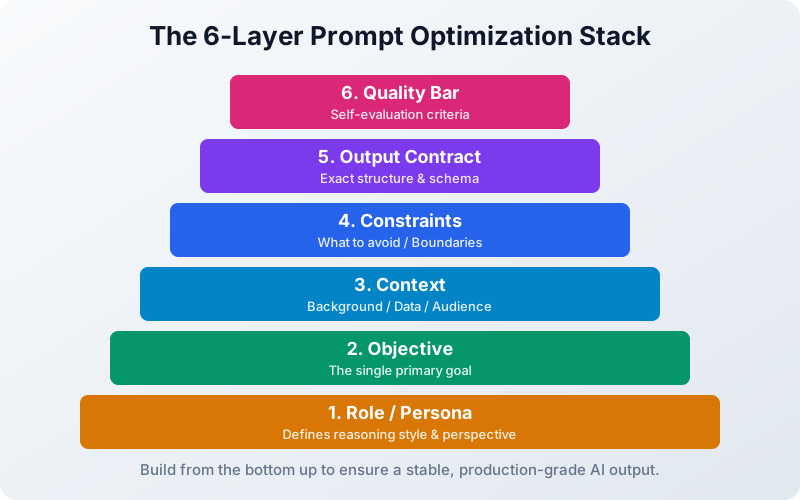
A production-grade prompt consists of these distinct layers, built from the bottom up to ensure stability:
1. Role / Persona (The Foundation)
The role establishes the model's perspective, its inherent biases, its vocabulary, and its level of abstraction. By defining a role, you instantly prune the massive probability space of possible next tokens.
- Weak: "Explain quantum cryptography."
- Strong: "Act as a post-doctoral researcher in quantum cryptography who frequently teaches undergraduate physics. Use clear analogies, avoid overly dense mathematical proofs where possible, but maintain strict scientific accuracy."
2. Objective (The Core Task)
This defines exactly what success looks like. It must be a singular, executable command. If you have five objectives, you should likely have five separate prompts.
- Weak: "Write something about our new AI tool."
- Strong: "Draft a 400-word introductory email sequence designed to convert free-tier users to the paid Pro tier by highlighting the time-saving benefits of the new bulk-edit feature."
3. Context (The Ground Truth)
The model knows nothing about your specific situation. Context provides all required inputs, proprietary data, background history, and audience specifics. Missing context equals hallucinations.
- Example: "Our target audience consists of B2B SaaS founders with less than $1M ARR. They are primarily concerned with churn rate and customer acquisition cost. They typically have engineering backgrounds but lack deep marketing experience."
4. Constraints (The Boundaries)
Constraints are arguably the most critical element when learning how to improve AI prompts. They set absolute boundaries that prevent the model from breaking character, topic, or format. Negative constraints (telling the model what not to do) are highly effective.
- Example: "Do not use corporate jargon like 'synergy' or 'paradigm shift'. Do not exceed three paragraphs. Never guess facts; if information is missing from the provided context, state 'Data Not Provided'."
5. Output Contract (The Structure)
Structured outputs drastically improve reliability and parse-ability. Mandate that the answer returns in a specific format. Failing to define the output shape often results in a massive, unreadable wall of text.
- Example: "Format the output as a Markdown table with the following columns: Feature Name, Primary Benefit, Engineering Complexity (Low/Medium/High), and Estimated Implementation Time."
6. Quality Bar (The Self-Evaluation)
Senior prompt engineers instruct the model on how it should evaluate its own response for excellence before outputting it. This acts as an internal quality assurance loop.
- Example: "Before generating the final output, ensure that the tone is empathetic but authoritative. The resulting text should read at the level of a top-tier McKinsey publication."
The Golden Equation for How to Improve AI Prompts
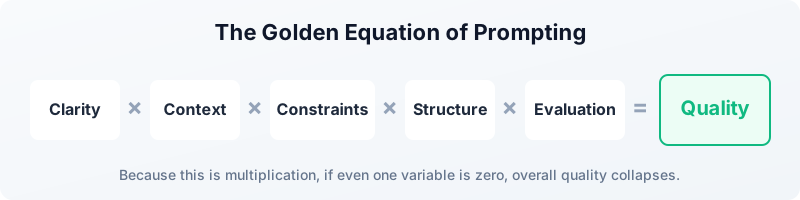
High-performance prompts follow a simple, almost mathematical reality that governs the final quality of the generated text:
Clarity × Context × Constraints × Structure × Evaluation = Quality
This equation highlights a crucial principle: because this is a multiplication function, if even one of these variables is completely zero (for example, you provide absolutely no constraints or structure), the overall quality of the output effectively collapses to near zero. A prompt can be beautifully clear and rich in context, but if you fail to constrain the model's verbosity or provide a structural contract, the result will be a rambling mess that requires heavy manual editing. To reliably improve AI prompts, you must maximize every variable in this equation.
Deep Dive into Context Engineering: Your #1 Performance Multiplier
If you are committed to learning how to improve AI prompts, you must become an expert in Context Engineering. Language models are fundamentally stateless predictors. They do not know what you asked them yesterday, they do not know your company's brand voice, and they cannot magically intuit the hidden constraints of your project.
The Power of Few-Shot Prompting
One of the most robust ways to provide context and improve AI prompts is through "Few-Shot" prompting. Instead of merely describing what you want the model to do, you show it. By providing 2 to 3 high-quality examples of the input-output mapping within the prompt, you anchor the model's pattern recognition capabilities.
- Zero-Shot (No examples): "Classify this customer review as Positive, Neutral, or Negative."
- Few-Shot (With examples): "Classify customer reviews. Review: 'The app crashed twice, but customer support was helpful.' -> Neutral. Review: 'Absolute garbage, I want my money back.' -> Negative. Review: 'Game changer for our team!' -> Positive. Now classify this Review: 'It works okay most of the time, UI is a bit clunky.'"
Few-shot prompting drastically reduces the ambiguity of the task. It is often more powerful and token-efficient than writing long, complex paragraphs of instructional rules.
Implementing Retrieval-Augmented Generation (RAG) Concepts Manually
In enterprise software, AI systems use RAG to retrieve documents from a database and dynamically inject them into the prompt. As an individual user trying to improve AI prompts, you can act as the manual retriever. Before asking the AI to write a report, copy and paste the preceding research docs, the previous meeting transcripts, or the raw data tables. Preface this data dump clearly:
CONTEXT MATERIAL BEGINS HERE:
[Paste Data]
CONTEXT MATERIAL ENDS HERE.
Then, follow up with your specific instructions. This dramatically reduces the likelihood of the AI inventing fictional data.
Advanced Techniques: Controlling Output Quality and Mitigating Hallucinations
When a language model hallucinates—fabricating facts, URLs, names, or code—it is usually because the prompt forced it into a probabilistic corner where making something up was the most mathematically likely next token. To improve AI prompts and prevent this, we use advanced control structures.
Forcing Reasoning Patterns (Chain of Thought)
Standard prompting asks the AI for an immediate answer. This is akin to asking a student to solve a complex calculus problem in their head without scratch paper. By using Chain-of-Thought (CoT) prompting, you force the AI to break down its reasoning explicitly before arriving at the final answer.
- Method: Add phases like "Think step-by-step," or "Before providing the final recommendation, detail your underlying assumptions and logical steps."
- Result: The model generates intermediate tokens that map out the logic, significantly reducing mathematical errors and logical leaps.
The Critic and Improve Pattern
Instead of accepting the first draft, bake an improvement loop directly into the initial prompt. You can instruct the model to act as its own editor.
- Example Prompt Structure: "1. Generate a first draft of the executive summary. 2. Act as a harsh, critical editor. Review the first draft and list three specific weaknesses regarding clarity and persuasiveness. 3. Based on your critique, rewrite the executive summary to be punchier and more compelling. Output ONLY the final version."
This multi-pass approach mimics human cognitive workflows. For coding specific implementations of this, check our AI Coding Prompts Guide.
Token Efficiency Optimization: Writing Faster, Cheaper Prompts
Senior prompt engineers don't just care about the output; they care about token economics. Every word you send to an API costs money and increases latency. Learning how to improve AI prompts also means learning how to be concise.
- Use Markdown as a Control Language: Language models natively understand Markdown. Use
#for headers,*for lists, and>for blockquotes to structure your prompt. This takes fewer tokens than writing "Here is a list of items..." - Replace Verbosity with Schema: Instead of saying, "I need you to give me the information in a very detailed way that includes the name, the date, and a summary of the facts," use code-like structures.
Output Format: JSON { "name": string, "date": string, "summary": string } - Use Delimiters for Separation: Use triple quotes
"""or XML tags<data></data>to clearly separate your instructions from your context material. This prevents the model from getting confused about what is a command and what is reference text.
Prompt Patterns That Consistently Work
If you want to immediately improve AI prompts without overthinking the theory, rely on established, high-performing templates. Here is a favorite among staff-level engineers:
The Comprehensive System Directive:
[ROLE]
You are a Staff Software Engineer at a Tier 1 tech company specializing in distributed systems and high-throughput data pipelines.

[OBJECTIVE]
Design a high-level architecture for a real-time event processing system.

[CONTEXT]
We expect 50,000 events per second. The engineering team is proficient in Golang and Kafka. We use AWS. Budget strictness is medium; latency must be sub 50ms.

[CONSTRAINTS]
- Do not recommend any Azure or GCP specific services.
- Assume an intermediate to advanced technical audience.
- Limit the architectural explanation to 3 core components.

[OUTPUT FORMAT]
Respond in Markdown.
1. Architecture Diagram (Use Mermaid.js syntax)
2. Component Breakdown (Bullet points)
3. Primary Trade-offs (Table format: Tradeoff | Pro | Con)
By standardizing your approach using templates like this, you guarantee a baseline of quality. For hundreds of ready-to-use, professional templates in marketing, sales, engineering, and more, you should explore our extensive Prompt Library.
Evaluating Your Success: The Prompt Quality KPIs
How do you know if you have successfully learned how to improve AI prompts? You evaluate your prompts just as you would evaluate software code.
- Clarity: Is the core task completely unambiguous? Could a human colleague read it and immediately understand the goal without asking clarifying questions?
- Context Completeness: Does the model literally have everything it needs to know? If it has to make an assumption to complete the task, your context is weak.
- Structural Integrity: Did you define the output shape? If the model returns a dense paragraph when you needed a checklist, your output contract failed.
- Control and Adherence: Did the model follow your negative constraints? If you said "no jargon" and it used the word "synergize," your constraints need to be tighter or repeated closer to the end of the prompt.
- Zero-Shot Success Rate: Can you run the prompt on a new set of data and get a usable result on the first try without needing a follow-up clarification message? This is the holy grail of prompt optimization.
Conclusion and Next Steps
The goal of prompt engineering is not simply getting "better answers" once. The true Key Performance Indicators of a senior prompt engineer are consistency, predictability, cost efficiency, and composability. When you master how to improve AI prompts using the 6-Layer Stack and the Golden Equation, you transform generative AI from a novelty toy into a deterministic, highly reliable operating system for your professional life.
To take the next step in your journey, start applying these frameworks to your daily tasks. Audit your past prompts. Where did they fall short? Did you miss the output contract? Was the role undefined?
If you want to see these principles applied automatically to your own work, try our free Prompt Optimizer Tool. Simply paste your weak, conversational prompt into the optimizer, and our specialized AI will rewrite it into a highly structured, constraint-driven master prompt guaranteeing exponentially better results.
Start optimizing today, and take full control of your AI outputs.
Written by Engineering Team, ImprovePrompt. Last updated March 8, 2026. Explore our full homepage for more resources.
Frequently Asked Questions
What is the best way to improve AI prompts quickly?
Why do my AI prompts generate hallucinations or fake data?
What is the 6-Layer Prompt Optimization Stack?
How do I ensure ChatGPT output is not generic or boring?
Start Writing Better Prompts
Ready to put these techniques into practice? Our free AI prompt optimizer analyzes your intent and rewrites your request for maximum effectiveness.
Optimize Your Next Prompt Now