
Write Bug-Free Code: The Developer’s Guide to AI Prompts (2026)
Stop debugging your prompts. Learn how to optimize AI prompts for coding using context marshalling, few-shot logic, and technical constraints to get production-ready code.

How to Optimize AI Prompts for Coding (With Examples)
If you are a developer using AI coding assistants in your daily workflow, you know that the output you get is only as good as the input you provide.
Quick Summary:
- Context Marshalling: Use pseudo-XML tags (
<schema>,<code>) to group relevant classes and interfaces. - Chain-of-Thought: Force a
<PLANNING>block before the implementation to map out architecture. - Few-Shot Patterns: Provide 2-3 examples of custom UI syntax to override model biases.
- Test-Driven Prompting: Provide a Jest/Pytest suite and demand the AI pass it perfectly.
- Negative Bounding: Explicitly forbid deprecated libraries or O(n^2) logic.
Simply asking an LLM to "build a React component" often results in generic, unoptimized, or buggy code that requires heavy refactoring. To truly Optimize AI Prompts for Coding, you need to treat prompt engineering like writing a highly specific technical specification.
In the fast-evolving landscape of artificial intelligence software development, optimizing your inputs can mean the difference between cutting your development time in half and spending hours debugging hallucinated boilerplate. The goal is to move past conversational queries and instead format your prompts with rigid structures, explicit constraints, rich context, and step-by-step reasoning protocols. If you're currently relying on zero-shot "do this for me" commands, you are drastically underutilizing the capabilities of modern models like GPT-4 or Claude 3.5 Sonnet.
Throughout this comprehensive guide, we will break down exactly how you can Optimize AI Prompts for Coding by utilizing advanced techniques such as context marshalling, Few-Shot prompting, and Chain-of-Thought reasoning. Whether you're a junior dev learning the ropes or a senior engineer architecting microservices, applying these exact templates and methodologies will instantly upgrade the quality, security, and performance of the code your AI generates.
Don’t forget—you can always try out our free Prompt Optimizer tool on the homepage to instantly refine your raw development prompts before you paste them into your IDE. Let's dive deep into the strategies that will transform your AI assistant from a chaotic junior developer into a highly focused, senior-level pair programmer.
What Does It Mean to Optimize AI Prompts for Coding?
When we talk about the need to Optimize AI Prompts for Coding, we are referring to the systematic process of structuring your text inputs to systematically reduce ambiguity and guide the Large Language Model (LLM) toward a highly deterministic, syntactically correct, and domain-appropriate output. Generative AI models predict the next token based on the statistical probabilities established during their training. Because their training data includes millions of low-quality GitHub repositories and outdated StackOverflow threads alongside the high-quality ones, a vague prompt gives the AI the freedom to sample from that generic, lower-quality pool.
Optimization is the act of narrowing the AI's probability distribution. By explicitly defining the tech stack, the architectural patterns, the performance constraints, and the expected edge cases, you effectively fence the AI into the highest-quality region of its latent space. You are no longer asking it what to write; you are instructing it on how to write it within your specific operational parameters.
If you are completely new to writing basic prompts, you might want to start with our foundational guide on Prompt Engineering for Beginners before utilizing the advanced coding techniques discussed here.
The Shift from Descriptive to Prescriptive
Most developers start their AI journey using descriptive prompting. They describe the symptom or the end goal. For example: "Write a python function to parse this CSV file." This is poorly optimized. The AI doesn't know what library you prefer (built-in csv, pandas, numpy), it doesn't know how robust the error handling should be, and it doesn't know the memory constraints of your environment.
A highly optimized prompt is prescriptive. It dictates the rules of engagement. For example: "Acting as an expert Python data engineer, write a function to parse the provided CSV using the built-in csv module. Use generators to yield rows one by one to avoid OOM exceptions on 5GB files. Implement tight try/except blocks handling UnicodeDecodeError and csv.Error. Output only the function and a single docstring, no markdown explanations."
This level of precision is the cornerstone of how an expert developer must Optimize AI Prompts for Coding.
Strategy 1: Establish Strict Roles & Constraints
The absolute first step to optimizing any code generation prompt is to establish the persona and the bounding box. Language models suffer from context spread—if you ask for a feature, they might try to build it using the most popular, generalized approach. By assigning a hyper-specific role, you immediately anchor the model's vocabulary and assumptions to a specific discipline.
The Power of the Persona
Instead of simply asking for code, assign the AI a persona that embodies the exact expertise you require.
Bad Prompt:
"Create a SQL query to get users who haven't logged in recently."
Optimized Prompt:
"You are an elite PostgreSQL Database Administrator with 10 years of experience in query optimization. Your goal is to write a highly performant, index-aware SQL query to retrieve users who haven't logged in over the last 30 days."
By defining the role ("elite PostgreSQL DBA") and the priority ("highly performant, index-aware"), the AI will automatically lean towards using constructs like EXISTS, proper table aliasing, and avoiding full table scans.
Enforcing Technical Constraints
Constraints are the guardrails that prevent the AI from hallucinating unnecessary libraries or utilizing deprecated syntax. Your prompts must explicitly state what the AI is not allowed to do.
- Allowed Libraries: "Use ONLY vanilla JavaScript. Do NOT use jQuery or Lodash."
- Version Pinning: "Write this component using React 18 syntax, exclusively utilizing functional components and hooks."
- Performance Ceilings: "The algorithm must operate at O(n) time complexity and O(1) space complexity."
- Format Constraints: "Provide ONLY the raw code block. Do NOT include conversational filler, greetings, or explanations of how the code works."
If you find yourself manually adding these constraints every time, consider using our Prompt Library to save your most heavily constrained meta-prompts.
Strategy 2: Chain-of-Thought (CoT) Prompting for Logic Algorithms
One of the greatest weaknesses of LLMs in software development is complex mathematical or algorithmic reasoning. Because they generate text token by token, they generally do not "think ahead" to plan the overall architecture of a complex function before they start typing. This leads to logic loops, nested if statements that don't satisfy all edge cases, and brittle logic.
To solve this, developers must utilize Chain-of-Thought (CoT) prompting.
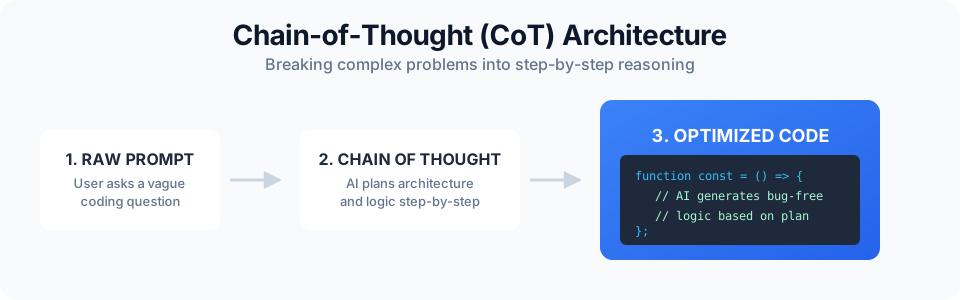
Chain-of-Thought forces the AI to break down its reasoning explicitly in the output window before it writes the actual code. By forcing the model to generate the logical steps as text, you actually populate the model's context window with a correct blueprint, which heavily increases the statistical probability that the subsequent code perfectly matches that blueprint.
How to Implement CoT for Coding
To trigger this behavior, you should append specific instructions directing the AI to draft pseudo-code or step-by-step logic.
Example CoT Prompt:
"I need a TypeScript utility class that takes an array of nested objects and flattens them into a single-depth key-value map. The keys should use dot notation indicating their original depth (e.g.,
user.profile.address.zip).BEFORE writing any code, please output a
<PLANNING>block. Inside this block, write out the step-by-step algorithm in plain English, addressing how you will handle array anomalies, circular references, and null values. Only after the planning block is complete, output the final TypeScript code."
Why This Works
When the AI is forced to write out "Step 1: check for circular dependencies using a weakly held set," it has now embedded the concept of circular dependencies into the immediate context window. When it transitions to writing the code, the attention mechanism of the transformer architecture will heavily weight the planning block, almost guaranteeing that the final code will include a WeakSet to track visited nodes.
If you are trying to write critical infrastructure logic and you do not require a
Strategy 3: Dynamic Context Marshalling
LLMs operate entirely within the vacuum of their immediate context window. If you ask an AI to "update the user authentication service," but you fail to provide the existing authentication service code, the database schema it relies on, or the JWT library you are using, the AI is forced to guess.
Over 90% of "bad AI code" is the direct result of context starvation. Optimizing prompts for coding requires you to master Context Marshalling—the art of gathering the minimum viable context from your repository and injecting it cleanly into your prompt.
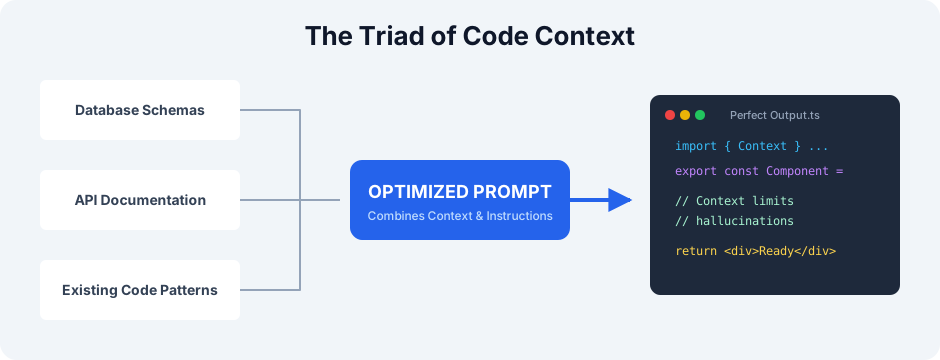
The Triad of Code Context
When querying an AI for a non-trivial code change, your prompt should ideally contain three distinct pieces of context:
- The Target Code (The "What"): The specific function, class, or file you want modified.
- The Dependency Schema (The "How"): The types, interfaces, or database schemas that dictate the shape of the data flowing into the target code.
- The Environmental Guidelines (The "Rules"): Your team's specific routing conventions, error handling mechanisms, or testing frameworks.
Framing the Context
Do not just paste 5,000 lines of code into the chatbox unstructured. Modern LLMs like Claude 3 or GPT-4o are very good at parsing XML tags. Structure your context clearly so the attention heads can differentiate between your instruction and your codebase.
Optimized Context Prompt Structure:
"I need you to write a new specific feature.
Here is my database Prisma schema so you know the data shape:
<schema>[paste schema...]</schema>Here is a similar existing controller demonstrating our required error handling patterns:
<example_controller>[paste controller...]</example_controller>Your Task: Based EXCLUSIVELY on the data shapes in the
<schema>, write a new controller that mimics the exact error handling shown in the<example_controller>. The new controller needs to handle fetching a list of active subscriptions."
By cordoning off the context using pseudo-XML tags, you dramatically reduce the chances of the AI confusing the reference material with the actual task it needs to perform.
Strategy 4: Few-Shot Example-Based Generation
When you need an AI to output code in a highly specific, idiosyncratic format that isn't widely popular on GitHub, zero-shot prompting (asking it to do it blindly) will almost always fail. The AI will inevitably revert to a standard, vanilla implementation.
Few-Shot Prompting is the technique of providing the AI with one or more explicit examples of the input-output pattern you desire.
Driving Consistency via Examples
Imagine you have a custom, in-house UI component library that doesn't follow standard Tailwind or Material UI conventions, and you want the AI to generate forms using your library.
Zero-Shot (Fails): "Build a login form using our custom UI components." (The AI doesn't know your components).
Few-Shot (Succeeds):
"You need to generate a new registration form. You MUST use our internal component library syntax.
Example 1: Input: Build a generic text input for a first name. Output:
<CustomInput variant="primary" label="First Name" bindModel={user.firstName} />Example 2: Input: Build an outlined submit button. Output:
<CustomButton outline theme="dark" action="submit">Submit</CustomButton>Your Task: Build a full registration form featuring inputs for Email, Password, and a Submit button. Follow the exact syntax patterns demonstrated in the examples above."
Few-Shot prompting fundamentally rewires the model's immediate behavior, prioritizing your explicit demonstrations over its pre-trained biases. It is the most robust way to ensure that AI-generated code will actually compile within complex, proprietary enterprise environments.
Strategy 5: Test-Driven Prompt Generation
One of the most robust, yet underutilized, techniques to optimize AI prompts for coding is Test-Driven Prompting (TDP). This borrows the philosophy of Test-Driven Development (TDD) and applies it to the prompt engineering layer.
Instead of writing a massive prompt outlining all the intricate logic of a complex function, you instead write a prompt that provides the AI with a suite of unit tests that the function must pass. This creates an objective, mathematical constraint that the AI cannot easily talk its way out of.
The Objective Guardrail
When an AI writes a feature based purely on a natural language description, the concept of "done" or "correct" is highly subjective. By providing tests, you create an unbreakable contract.
The Test-Driven Prompt:
"I need you to write a JavaScript function called
calculateTaxBracket(income, state).Do not ask me for clarification. The function you write MUST pass the following Jest test suite perfectly:
test('it calculates baseline federal tax', () => { expect(calculateTaxBracket(50000, 'TX')).toBe(6000); }); test('it applies specific state surcharges', () => { expect(calculateTaxBracket(100000, 'CA')).toBe(15000); }); test('it throws an error on negative income', () => { expect(() => calculateTaxBracket(-100, 'NY')).toThrow('Invalid income'); });Please generate the function implementation. Output strictly the JavaScript code block."
This methodology works exceptionally well because LLMs are highly proficient at reverse-engineering logic from assertions. If the AI provides an output that fails the tests when you copy it to your IDE, your subsequent prompt is simply pasting the terminal error trace back into the AI. "It failed test 2 with Received: 14000, fix the implementation."
This creates a tight, rapid iteration loop that removes human interpretation from the debugging process.
Why Failing to Optimize AI Prompts for Coding Costs You Time
You are reading this because you want to write code faster. But if you do not actively practice these optimization protocols, AI tools actively become a time sink, creating an illusion of speed while secretly drowning your repository in technical debt.
When developers use lazy, unoptimized prompts, the AI usually generates code that looks highly plausible. It will use correct variable names, standard patterns, and compile without initial errors. However, because the prompt lacked constraints and edge-case planning via Chain-of-Thought, this code is often highly inefficient, riddled with subtle race conditions, or vulnerable to security injection attacks.
You end up saving 30 minutes writing the initial boilerplate, only to spend 3 hours debugging a silent failure in production three weeks later. Proper prompt engineering is not about generating code faster; it is about generating maintainable, secure code on the first generation attempt.
Every minute you spend crafting an iron-clad prompt, establishing pseudo-XML context, and defining Few-Shot examples pays off logarithmically by eliminating the endless cycle of "that didn't work, try again" prompting loops. If you want to systematically Optimize AI Prompts for Coding, you must treat the AI as an incredibly fast, obedient, but dangerously literal intern. Give it iron-clad specs.
Final Thoughts & Next Steps
AI coding assistants are the most powerful productivity amplifiers introduced to software engineering since the IDE itself. However, tapping into their true potential requires mastering the interface layer: the prompt. By employing strict role definitions, leveraging XML-style context grouping, enforcing mathematical constraints through Test-Driven Prompting, and demanding Chain-of-Thought planning protocols, you can transform AI hallucinations into robust, production-ready system architecture.
The era of "just asking ChatGPT to write it" is over. We have entered the era of precision engineering. Start applying these frameworks to your daily workflow and watch your sprint velocity metrics soar.
Ready to implement these strategies instantly? Stop manually formatting your context every time and start using professional optimization architecture. Try our completely free Prompt Optimizer tool on the homepage today! Take your raw, messy development request, run it through our tool, and watch it transform into an elite, highly-structured blueprint guaranteed to generate superior code.
Frequently Asked Questions
Why does my AI coding assistant generate buggy code?
What is Chain-of-Thought prompting in coding?
How do I optimize AI prompts for coding in large codebases?
Is Test-Driven Prompting effective?
Start Writing Better Prompts
Ready to put these techniques into practice? Our free AI prompt optimizer analyzes your intent and rewrites your request for maximum effectiveness.
Optimize Your Next Prompt Now